9.1 Why write it down
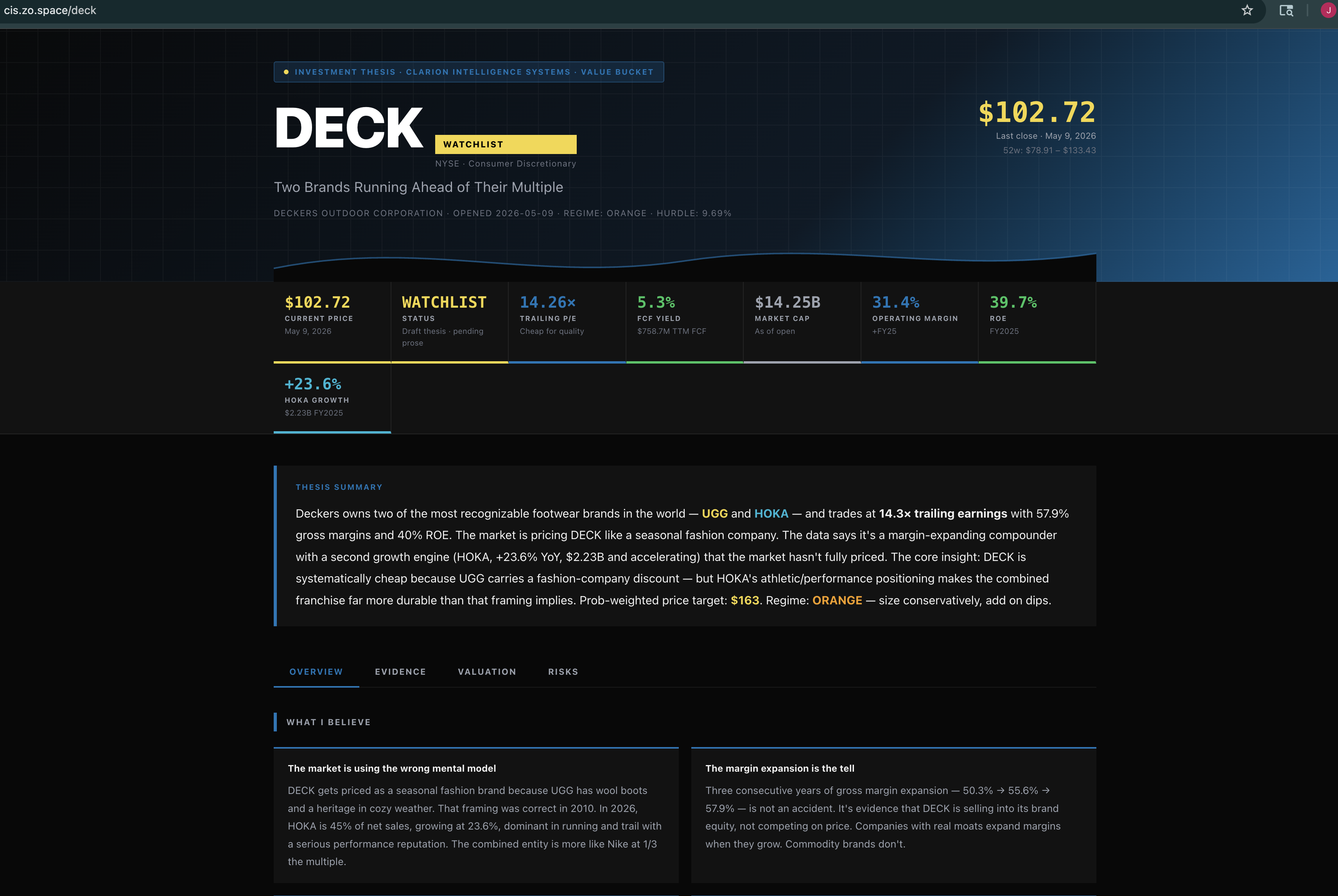
A thesis is the document that justifies putting capital into a name. Writing it down does three things at once:
- It forces you to be specific. Vague convictions do not survive being typed.
- It gives you something to score — the system can grade a thesis only after it exists.
- It gives you something to monitor and to update when the world changes — the topic of the next chapter.
Without a written thesis, you have an opinion. With one, you have a position you can defend, monitor, and eventually exit on facts rather than feelings.
9.2 What the system writes for you
The clarion-thesis-write skill scaffolds a markdown file in your workspace at ~/clarion/theses/<TICKER>.md with all the sections in the canonical order, pre-filled with what the system already knows (filings cited, fundamentals, regime context). Your job is to fill in the prose — with the help of the Clarion Thesis Architect persona, which is deliberately picky about vague claims.
· 10-K and 10-Q indexed.
· Buffett-lens evaluation already run (verdict: Watchlist at $66).
· No existing thesis file for KO.
· Bucket: value (confirmed).
Scaffolded
~/clarion/theses/KO.md with these sections ready to fill:(1) What I Believe — the core thesis in 1-3 paragraphs.
(2) Why I Believe It — numbered evidence with filing citations.
(3) What It Is Worth — bear / base / bull scenarios with the math.
(4) Kill Conditions — three specific events that would break it.
(5) Why Now — the catalyst, or the patience argument.
Three filing citations pre-seeded as starting evidence. Ready to work through section 1 with you.
9.3 How the system scores a thesis
Once a thesis is written, the system grades it on six components. Each one gets a score on a comparable scale; the components combine into an overall score that maps to an action.
| Component | What it measures |
|---|---|
| Valuation safety | Current price versus the base case fair value you wrote into the thesis. The bigger the discount, the higher the score. |
| Business health | Quality of the underlying operations: margins, returns on capital, balance-sheet strength, revenue trend. |
| Insider alignment | Are officers and directors buying or selling their own shares? Read from Form 4 filings. |
| Catalyst proximity | Is there a near-term event — earnings, a product launch, a regulatory decision — that could move the price toward fair value? |
| Thesis integrity | Is the original thesis still consistent with the most recent filings, or have new disclosures undermined it? |
| Risk environment | The current regime, applied to this kind of position. A cyclical name takes a bigger penalty in red than a staple does. |
The six numbers are combined into an overall score. The overall score and any triggered kill conditions decide the action.
9.4 The action ladder
9.5 Sizing the position
Score tells you direction (add / hold / reduce / exit). It does not tell you how much capital to put in. That is a separate decision, and a simple one once the thesis is written.
Three constraints apply, in order:
- Bucket cap. Long single-name equity ideas live in the Value bucket, which has a regime-adjusted target. In a friendly regime that bucket is roughly 55% of the portfolio; in danger it drops to 40%.
- Single-position cap. No single equity position exceeds 10% of the total portfolio. Most positions land in the 2-5% range. The 10% cap is a ceiling, not a target.
- Conviction tilt. Within those limits, conviction (the thesis score and the size of the discount to fair value) decides where in the range a position sits. A higher-conviction thesis gets a larger weight inside the cap.
Single-position cap: 10% of portfolio.
Conviction tilt for a score of 64: roughly 3% of the portfolio, on the lower half of the typical range.
Recommended target: 3% of the portfolio. Build in two to three tranches rather than all at once, in case price moves in your favor.
The sizing answer is intentionally narrow. The system will not tell you to put 20% of the portfolio in a single name even if the score is excellent — that limit exists because every investor, including the best ones, has been wrong about a high-conviction idea at least once.
9.6 Ready to act?
Before any capital moves, the thesis should clear a short checklist:
- The base case fair value is written into the thesis — this is what the monitor uses to recompute valuation safety later.
- At least three kill conditions are listed, each measurable in a filing or a price chart.
- Every claim in the “Why I Believe It” section cites a filing.
- The overall score is at least 55. Anything lower means the thesis itself is too thin to act on.
- The size is set: a percentage of the portfolio, not a dollar amount you happen to have lying around.
Key takeaways
- A written thesis is the entry ticket. No thesis, no capital.
- Six components feed the score: valuation safety, business health, insider alignment, catalyst proximity, thesis integrity, and risk environment.
- The score plus kill conditions produce an action: ADD, HOLD, REDUCE, or EXIT.
- Sizing comes from three constraints: bucket cap, single-position cap, and conviction tilt.
- A thesis with a score below 55 is too thin to act on — strengthen it or set the name aside.