6.1 Why this comes first
Every investment decision sits inside a market environment. The same stock can be a great buy in one environment and a terrible buy in another, even if nothing about the business has changed. Before you look at a single name, you want one sentence on what kind of market you are in.
Clarion calls this the regime. It is the first thing the system reports, every time. No stock conversation starts before the regime is on the table.
6.2 The four color days
The regime is read from two things: the S&P 500 (proxy for stocks) and long-dated US Treasury bonds. The system looks at the direction of each over the last 20 trading days. Whether stocks and bonds are moving together or apart tells you what money is doing.
| Color | Stocks vs. bonds | What it means |
|---|---|---|
| Green | Stocks up, bonds up | Cleanest deploy. A liquidity tide is lifting everything; the bond market is not signaling stress. |
| Blue | Stocks down, bonds up | Bonds doing their hedging job. Often a higher-odds add-on-weakness regime — the market is functioning as designed. |
| Orange | Stocks up, bonds down | Equities rallying despite bond stress. Caution — don ’t size up aggressively. |
| Red | Stocks down (≥5%), bonds down | Correlation breakdown. No safe-haven bid. Defensive posture; protect capital. |
There is also a danger state, which kicks in after a large drawdown from a recent high (about 20% off the prior year’s peak). In danger, the answer to “should I buy X?” is always “not yet” until the regime returns.
You do not need to memorize this table. The system reads the regime for you and tells you the color in plain language. The table is here so the word “orange” means something the next time you see it.
6.3 The hurdle rate, in plain English
Any time you buy a stock, you are choosing it over a safer alternative: a US Treasury bill, which pays a known rate of return with no business risk. The hurdle rate is the return you would need to beat that safer alternative by enough to justify taking the risk.
The math is intentionally simple:
The regime premium rises when the environment is less friendly. In a calm green or blue regime it is small; in red or danger it is large. That is the system’s way of saying: when the weather is bad, demand a bigger reward for showing up.
6.4 Asking the system
With the clarion-regime-check skill installed and the Clarion Macro Sentinel persona active, the conversation looks like this:
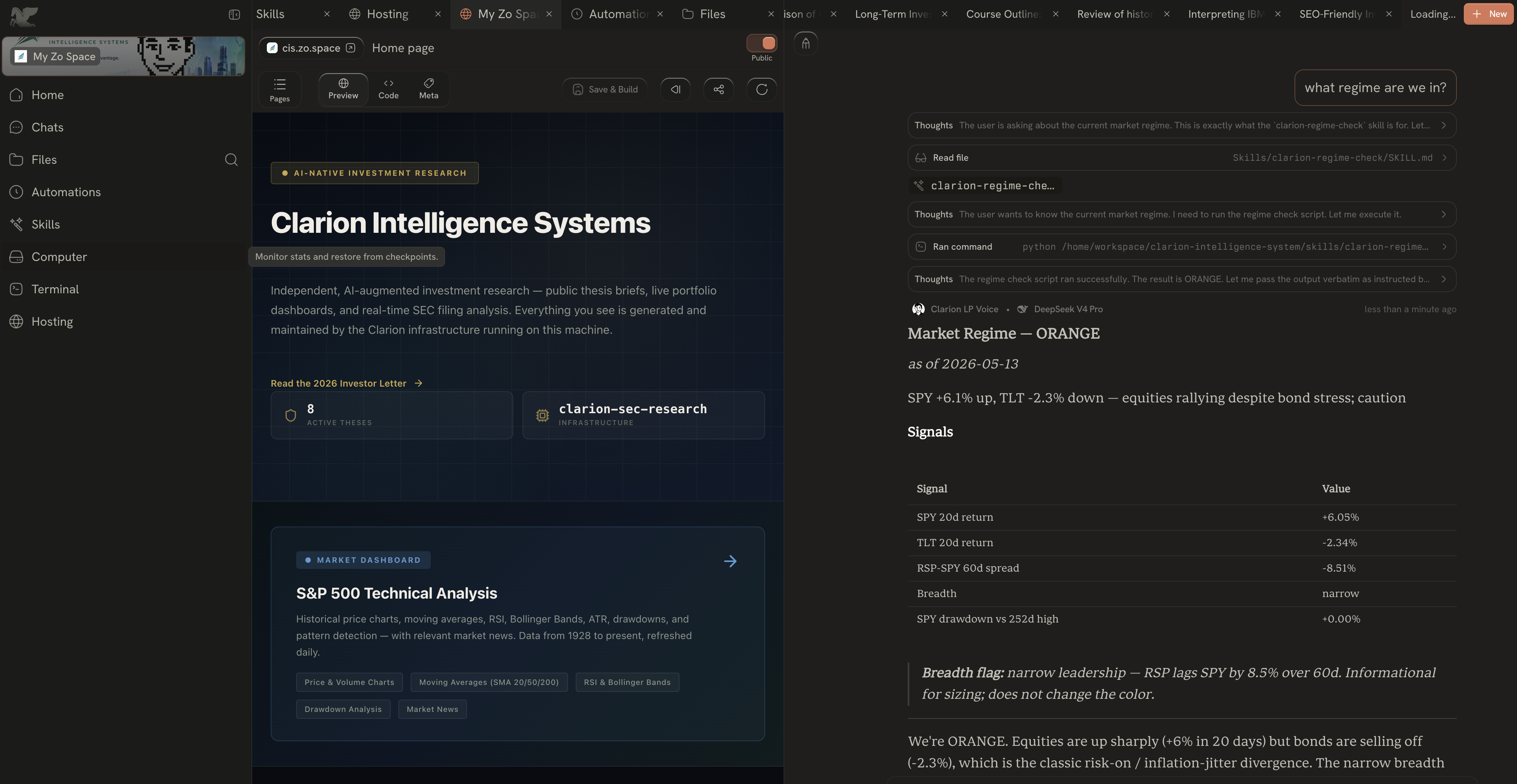
New long positions need to clear a 10.5% expected return to beat T-bills. Existing positions: hold unless a kill condition triggers.
Three things to notice. First, the regime color is the very first word. Second, every number has a clear meaning — no codes, no acronyms. Third, the answer ends with a decision implication: what does this mean for what I do next?
6.5 When the system goes further
For the Value bucket of your portfolio — the part that holds individual stocks — the system can answer a follow-up question: given today’s regime and today’s overall stock market valuation, should you favor stocks or T-bills inside that bucket?
Current S&P 500 Shiller CAPE: 32.4 — historically, that range has produced 0–3% per year over the next decade.
Verdict: Lean T-bills. The historical equity return at this valuation does not clear the 10.5% hurdle. Recommend roughly 30% stocks and 70% T-bills within the Value bucket until valuations come down or the regime improves.
The CAPE is a long-horizon valuation measure for the whole stock market — the higher it is, the lower the next decade of returns has tended to be. The system reads it from a public source, compares it to the hurdle, and produces a five-tier verdict from strong equity to maximum T-bills.
6.6 What this gets you
With one prompt and one persona you now have:
- A single word for the current environment: green, blue, orange, red, or danger.
- A specific hurdle rate that every new stock idea has to clear.
- A view on whether stocks at today’s overall valuation are even worth choosing over T-bills inside the Value bucket.
That is enough to start sourcing ideas in the next chapter.
6.7 When to refresh
- Before any new buy. Always check the regime before you size a position. Five seconds.
- Weekly. A weekly read gives you a sense of drift even when nothing dramatic is happening.
- After any move that surprises you. A sharp day in either direction is worth a re-read.
Key takeaways
- The regime is a one-word read of the market environment. Green, blue, orange, red, or danger.
- The hurdle rate is what a new stock idea has to beat. T-bill rate plus a regime premium.
- The Macro Sentinel persona owns this read and never wanders into individual stocks.
- A second prompt — based on the overall market’s valuation — tells you whether to favor stocks or T-bills in the Value bucket today.
- Check the regime before every new position, and at least once a week.