8.1 From a long list to a short list
You finished the last chapter with three to ten names on a watchlist. Most will not make it past today. The goal here is to ask each one a small number of questions, listen carefully to the answers, and pick the two or three that are worth a full thesis.
The system gives you two tools for that: access to the company’s own filings, and a structured way to evaluate any single business. Together they let you replace generic news commentary with answers grounded in primary sources.
8.2 The four lenses
Warren Buffett evaluates a business by asking four kinds of questions. Clarion bakes these into the system so every evaluation has the same shape.
8.3 Why filings are the source of truth
Every US public company is required by law to file detailed reports with the Securities and Exchange Commission. The big ones to know:
- 10-K. Annual report. The most comprehensive document a public company produces — business description, risk factors, management discussion, financial statements.
- 10-Q. Quarterly report. Lighter version of the 10-K for the quarters in between.
- Form 4. Insider transactions — whenever an officer or director buys or sells shares.
- 8-K. Material events — anything important that happens between regular reports.
These filings are signed documents. If a CEO says something on TV that contradicts the 10-K, the 10-K wins.
The catch: a 10-K is often 150 to 300 pages. No one is reading the whole thing for every name on a watchlist. The Clarion system takes care of that for you: it downloads filings from the SEC, breaks them into sections (risk factors, management discussion, etc.), and lets the AI quote the relevant section back to you with a citation.
8.4 Asking a 10-K a question
With the clarion-sec-research skill installed and the Clarion Analyst persona active:
“We continued to take price across most operating segments in 2025, with worldwide unit case volume up 2% and price/mix contributing approximately 7% to net revenue growth. We were able to pass through higher input costs without measurable degradation of consumer demand in our core sparkling portfolio.”
Citation: KO 10-K filed 2026-02-20 → MD&A / Net Revenue Discussion
Interpretation: management is claiming durable pricing power and has the unit-volume number to back it up — price went up 7% and volume still grew 2%. Worth confirming in 10-Q commentary across 2026 as the test of whether this is repeatable.
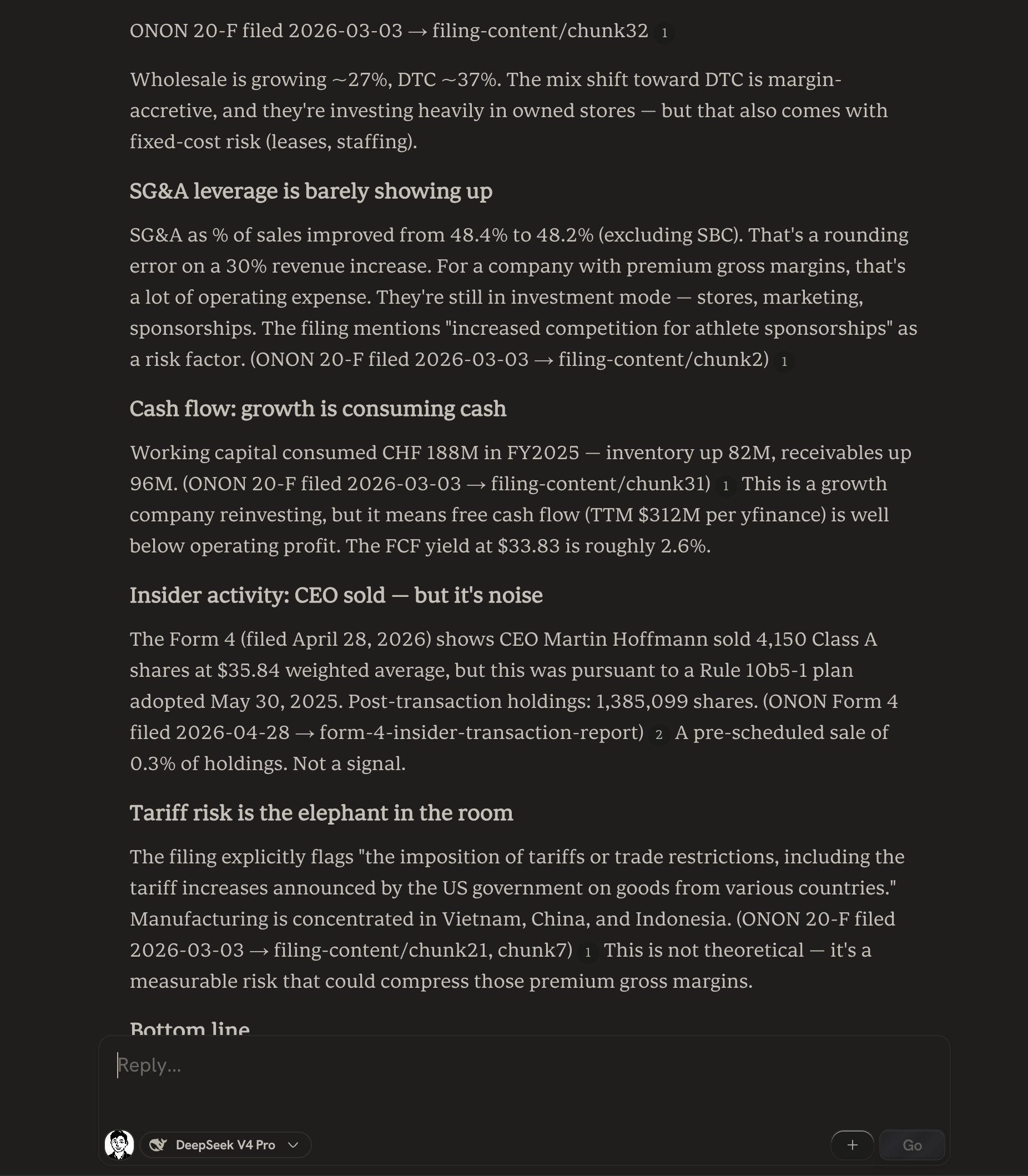
Two things to notice. First, every quote is followed by a citation pointing back to the specific section of the specific filing. Second, the AI separates the quote (the company’s own words) from the interpretation (what the AI thinks it means). Always keep those two layers separate.
8.5 The full evaluation
When you are ready for the full four-lens review of a single name, ask for it directly. The system pulls the snapshot of fundamentals, cross-references the regime, and quotes the relevant filing sections.
What I believe. KO is a durable cash-generative business with proven pricing power and a defensible global distribution moat. At $66 it is fairly priced for that quality, not cheap.
Why I believe it.
(1) 7% price/mix and +2% unit volume in 2025 — pricing power verified (KO 10-K filed 2026-02-20 → MD&A).
(2) Free cash flow yield 4.1% versus today’s 10.5% hurdle. Below the hurdle on cash yield alone.
(3) Insider activity over the last 6 months: net buying of $4.3M, no significant sales (Form 4 records).
What changes my mind.
(a) Operating margin compresses below 28% for two consecutive quarters.
(b) Unit volume turns negative for a full year.
(c) Price drops below $52 (gives a 5%+ free cash flow yield).
Why now (or not yet). Not yet. At $66 the implied annual return from holding the cash stream is around 4-6%, below the regime hurdle. Wait for either a price drop or a regime where the hurdle is lower.
This is the output you are looking for at this stage. Notice the shape: a verdict on the first line, evidence with citations, explicit conditions that would change the call, and a clear statement of why now or why wait.
8.6 The verdict, in three buckets
- Worth a thesis. Business quality is real, the numbers clear the hurdle, the risks are knowable. Move to the next chapter.
- Watchlist. The business is good but the price is wrong, or the regime is wrong. Note the entry conditions (“below $52”, “after a regime change”) and let the watchlist monitor tell you when they hit.
- Skip. Something is structurally off — the moat is unclear, management capital allocation is poor, the risks are too large or too hidden. Move on.
Two or three “worth a thesis” names from your starting list is a strong result. One is fine. Zero is also fine — it means the system is doing its job and refusing to pretend opportunities exist when they do not.
Key takeaways
- Four lenses: business quality, management, valuation, risk. Every name gets the same treatment.
- Filings are the source of truth. Every claim that survives this stage points back to a specific section of a specific document.
- The output of an evaluation is a verdict on the first line, evidence with citations, kill conditions, and a timing call.
- Three verdict buckets: worth a thesis, watchlist, or skip.
- Zero passing names is a legitimate result. The system is allowed to say nothing is worth doing today.