10.1 From thesis to order
A finished thesis tells you four things: the name, the target weight, the price you want to pay, and the kill conditions. Placing the trade is the boring step — you are just executing what the thesis already decided.
Two order types do almost everything you need.
- Market order. Buy or sell at whatever price is on the screen right now. Use this only when the price is already inside your acceptable range and you want to be filled today.
- Limit order. Buy or sell only if the price reaches a level you set. The order sits open until the market gets there or you cancel it. Use this when the thesis wants a specific entry price.
Clarion does not place trades for you. The system produces the decision; your broker executes it. The handoff is deliberate — a human places the order, looks at it on the screen, and signs off before capital moves.
10.2 What happens after the fill
Once a position is on, it joins the active positions tracker — a file in your workspace that records the ticker, entry date, entry price, target weight, current weight, the thesis score, and the kill conditions. Every open position has one row.
The tracker is the source of truth for what you own. Brokerage screens show you holdings; the tracker shows you holdings plus the thinking behind them.
10.3 The weekly thesis monitor
Once a week, ask the system to re-grade every open thesis against the latest data. With the clarion-thesis-monitor skill installed and the Clarion Portfolio Manager persona active:
Hold (5). JNJ, MKC, MDT, CL, PEP — all within thesis bands. No new evidence.
Add (1). KO. Score moved from 78 to 82 after stronger-than-expected Q1 pricing data. Below 4% target weight, room to add up to half the gap.
Review (1). LULU. Operating margin compressed for the second consecutive quarter — this hits kill condition (a) from the original thesis. Recommended action: reduce to half weight pending the Q2 print, exit if margin compresses again.
Full re-scored thesis cards saved to
~/clarion/monitor/2026-05-13.md.The monitor produces one of four actions for each position, in plain language.
- Hold. Nothing material has changed. The thesis is still doing its job.
- Add. Score improved or price dropped, and the position is under its target weight. The system will tell you how much room is left.
- Reduce. Score dropped or risk rose, but a kill condition has not triggered. Trim back to a smaller position size while you re-examine the thesis.
- Exit. A kill condition triggered, or the score fell below the action floor. The thesis no longer justifies the capital.
10.4 The Portfolio Manager persona
The Portfolio Manager persona owns one job: looking across all your open positions at once and producing the four-bucket action list. It will not write a fresh thesis. It will not pick a new name. It re-grades what already exists and tells you what to do today.
That narrowness is a feature. A single persona that does everything becomes unreliable. Seven personas that each do one thing well stay sharp. PERSONAS-AND-RULES documents each one.
10.5 The quarterly Living Letter
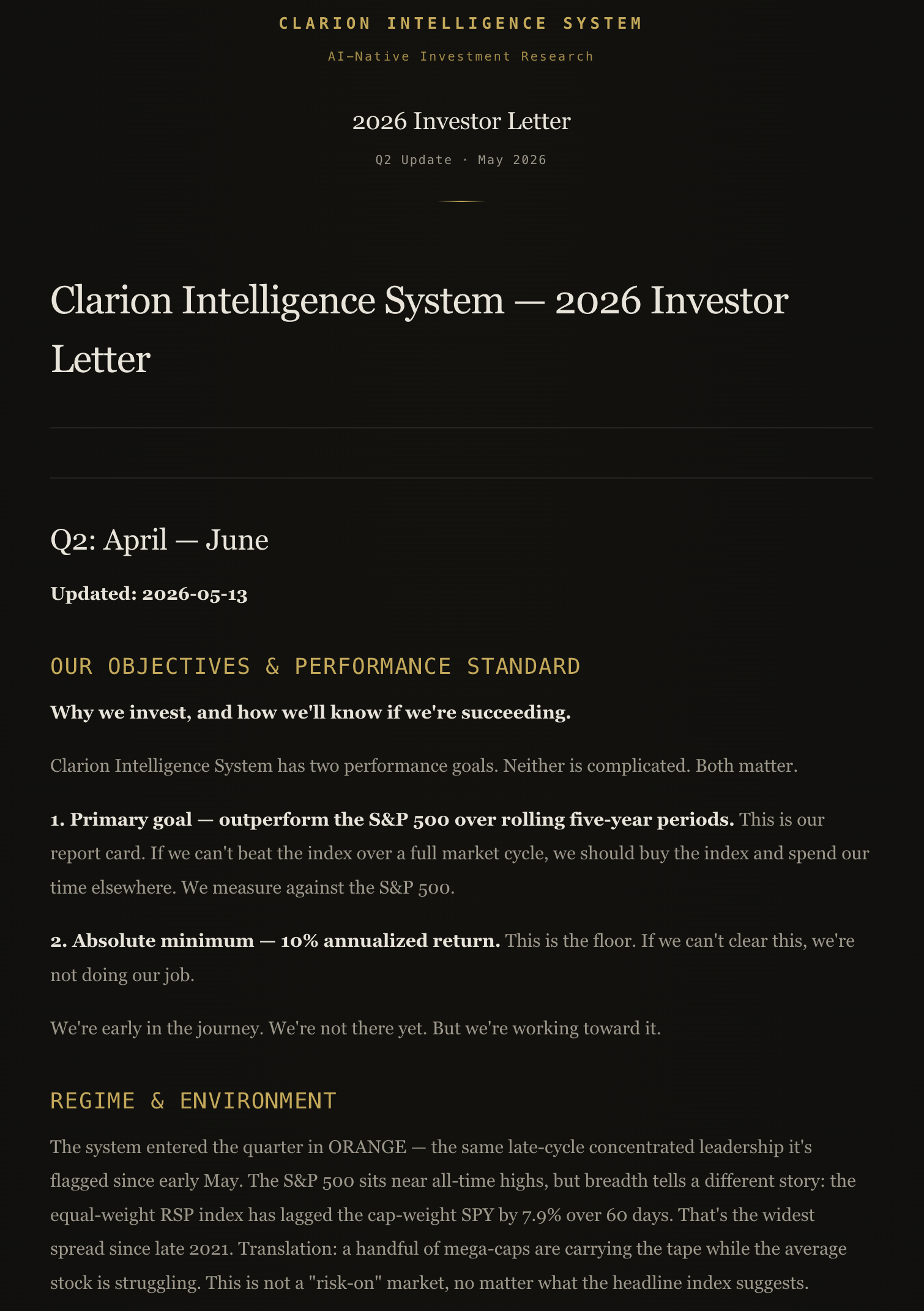
Every three months, the system writes you a letter. Not a performance report — a letter. It explains, in clear sentences, what you own, why you own it, what changed in the last quarter, and what you got wrong.
With the clarion-living-letter-update skill installed and the Clarion LP Voice persona active:
The portfolio returned 2.4% in Q2, against 3.1% for the S&P 500. We finished the quarter with seven equity positions (54% of capital), no short positions (regime did not warrant), and 46% in T-bills. The hurdle rate remained at 10.5% for most of the quarter.
What changed. We exited LULU at a 6% loss after operating margin compressed for a second quarter — kill condition (a) of the original thesis. We added to KO twice as Q1 pricing data confirmed the moat narrative. No new theses were initiated this quarter; the screener returned a thin list and we chose to wait.
What I got wrong. The LULU thesis under-weighted the risk that brand fatigue would show up in pricing power first and unit volume second. The system flagged margin compression on time. I did not flag the early warning signs that the qualitative narrative was already turning — review notes from the September thesis show I dismissed two short-seller reports that turned out to be directionally right.
What I am watching. AOS at $50 and a re-test of $52 on KO would put both names on the active list. T-bill yields drifting lower would tighten the hurdle and change what passes the screener.
Yours,
The system, on your behalf
The letter has a deliberate shape: how the portfolio did, what changed and why, what was wrong, and what is next. The voice is first-person, plain-spoken, and self-critical. There are no celebrations of wins and no euphemisms for losses.
10.6 The journal is the audit trail
Every thesis, every monitor run, every letter, and every change to the active positions tracker is written to your workspace as a timestamped Markdown file. That folder — ~/clarion/ — is the journal of every decision the system ever helped you make.
You can grep it. You can read it five years from now. You can attach it to a conversation when you need the AI to remember the original reasoning. The journal is the long memory the system needs to stay coherent across thousands of small decisions.
~/clarion/ and scroll through. You will spot patterns — the kinds of theses you write well, the kinds of regimes that fool you, the moments you talked yourself out of following a clear signal. That is the highest-leverage 30 minutes in the whole workflow.Key takeaways
- Trades follow theses, not the other way around. Use limit orders by default; market orders only when price is already in range.
- The weekly thesis monitor re-scores every open position and produces one of four actions: hold, add, reduce, exit.
- A kill-condition exit is the system doing the work you already did at the thesis stage. It is not a failure.
- The Portfolio Manager persona owns the monitor; the LP Voice persona owns the quarterly Living Letter. Each persona does one job.
- Every decision is written to
~/clarion/. That folder is your journal and your audit trail.